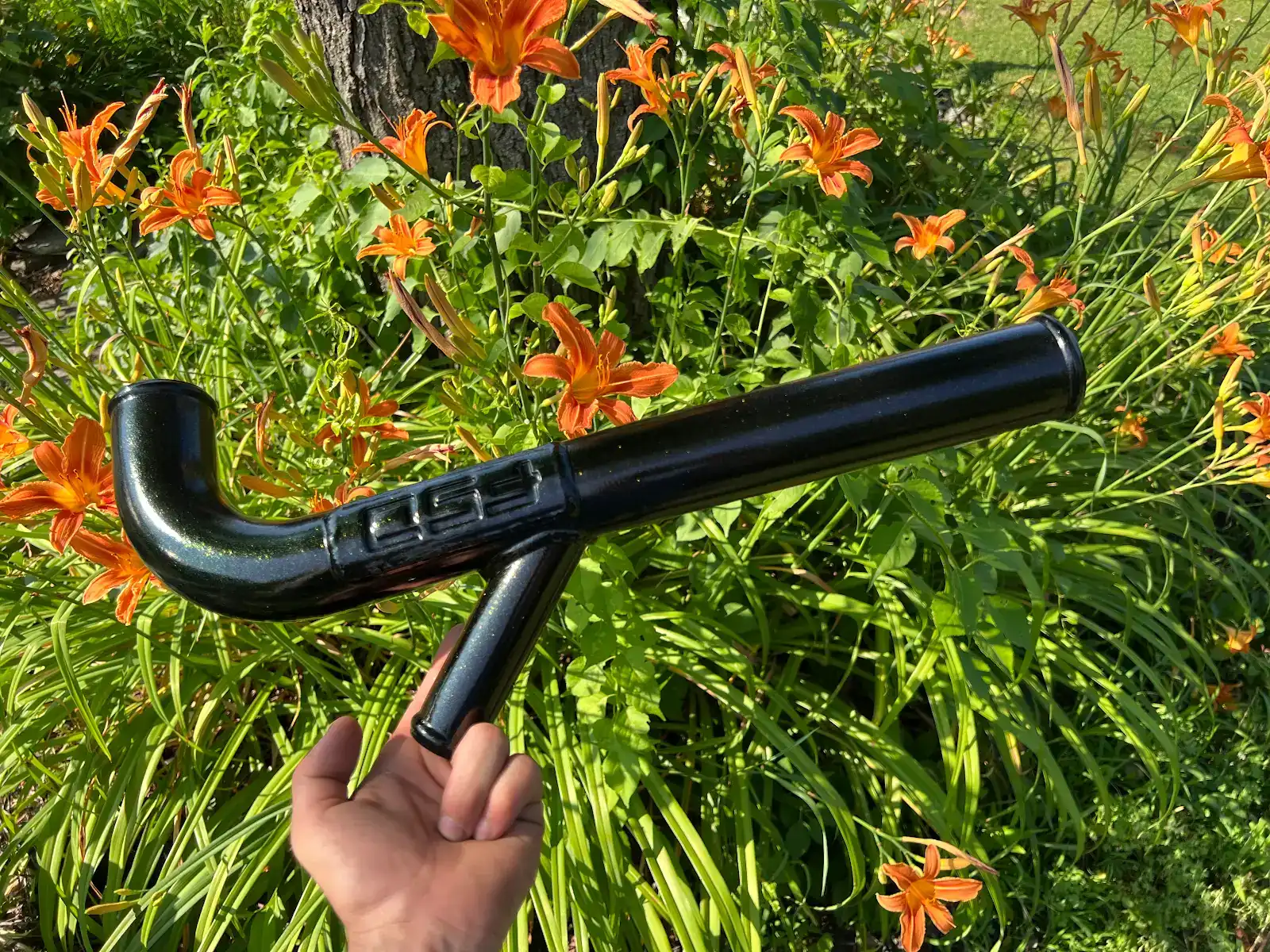
Powder Coat vs Spray Paint
Which finish survives Hudson Valley road salt, gravel and winter? A plain English breakdown for car, truck and equipment owners.
The Basics
Spray paint is liquid pigment and solvent brushed or sprayed on, then left to dry at room temperature. Powder coat is a dry polymer powder applied electrostatically, then cured in an oven at around 350 to 400 degrees F. The powder melts, flows into a continuous film, and bonds to the metal as it cools. That cure is the core difference.
Because the finish melts and flows together, it forms a single tough shell instead of stacked thin layers of wet paint. There is no solvent to evaporate, so there are fewer pinholes and less underfilm attack from road salt.
Durability and Chip Resistance
Callout. Powder coat resists chips, scratches and fuel spills far better than spray paint. On wheels, valve covers, brackets and trailer frames, that is the difference between a finish that lasts seasons and one that flakes the first winter.
Spray paint sits on the surface. A rock chip cuts straight through it to bare metal, and rust follows the chip edge. Powder coat is thicker and more flexible. A hit that would gouge spray paint often bounces off, or leaves a mark without breaking through to the steel.
For parts that see gravel, wrenches, boots and salt, powder coat is the standard for a reason. Spray paint is fine for items that stay clean and protected. Anything that lives on the road or in the shop gets powder.
Road Salt and Hudson Valley Winters
Road salt does two things. It is corrosive on its own, and it conducts electricity, so it speeds up galvanic corrosion between dissimilar metals. Once salt gets under a failing finish, it keeps working through the winter and into the spring.
Spray paint forms a thinner barrier with more pinholes, so salt finds a path to the metal sooner. Powder coat is thicker and seals better, so salt takes far longer to get a foothold. On a coated wheel or a powder coated bracket, a good finish can mean several seasons before you see rust creeping at an edge.
Prep Makes the Finish
Neither finish bonds to old paint, rust or grease. Both need bare, clean metal. The difference is that powder coat demands it. Any contamination trapped under the powder shows up as a defect when the finish cures, and the bond fails where the surface was not clean.
We blast to bare metal first. Blasting also creates a fine anchor profile that the powder physically grips. Attached rubber, plastic, seals and bearings come off before coating, because they cannot take the oven heat. Threads, bores and bearing surfaces get masked so powder does not build up where you need clearance.
The Cure
Spray paint dries as solvent evaporates. It can feel dry in an hour but takes days to fully harden, and it stays softer than powder. Powder coat cures in the oven at around 350 to 400 degrees F. The powder melts, flows out smooth, crosslinks chemically, and locks to the metal.
Callout. That oven heat is why plastic, wood and rubber cannot be powder coated. They melt or burn well before the cure temperature. Those parts stay with paint or a different finish.
What Drives the Cost
We do not quote a fixed price per part here, because every job is different. What drives the cost is size and number of parts, how much old paint and rust needs stripping, blasting and prep time, repairs uncovered after blasting, masking complexity, and the finish and color choice. Metal flake and specialty finishes take more steps and more material, so they cost more than a single color gloss.
The easiest way to get a real number is to text photos with a tape measure in the shot, or drop the part off at the shop in Wallkill.
| Factor | Powder Coat | Spray Paint |
|---|---|---|
| Durability | High | Low to medium |
| Chip resistance | High | Low |
| Road salt | Resists for seasons | Fails in one winter |
| Prep | Blast to bare metal | Clean and scuff |
| Cure | Oven, 350 to 400 F | Air dry |
| Metal only | Yes | No |
| Cost drivers | Size, prep, finish | Labor, coats |
The Verdict
If the part is metal and it sees road salt, gravel, wrenches or weather, powder coat wins. If it is plastic, wood or rubber, or it lives inside and stays clean, spray paint can do the job. When in doubt, text a photo and Devin will tell you straight which finish fits your part.
Not sure if your part can be powder coated? Try the free checker tool first. It asks four quick questions and gives you an instant answer.
Ready to Coat Your Part?
Call Devin or send photos. We strip, coat and cure in one Wallkill shop.
Call (845) 527-0065